The consultation has ended on 5 August 2026.
What is Changing,
and What is Still Missing?
and What is Still Missing?
After more than two decades of discussion, the current administration has finally announced its commitment to implementing reforms and passing the necessary legislation within its current term (by July 2027). On 7 July 2026, the Security Bureau launched a one-month public consultation on Improving the Laws on Sexual Offences in Hong Kong. The consultation paper encompasses numerous recommendations put forward by the Law Reform Commission (LRC) and addresses several points raised by the Association in our position paper, Towards a More Comprehensive and Timely Direction for Sexual Offence Law Reforms.
This page outlines the primary response and key recommendations of the Association Concerning Sexual Violence Against Women regarding the consultation document.
-
1971: Enactment of the Crimes Ordinance (Cap. 200)
Hong Kong's sexual offence laws were largely modelled on the UK’s Sexual Offences Act 1956. However, the UK undertook comprehensive law reform in 2003, replacing most of these outdated provisions with modern offences.
JUL 2006: July 2006: Formation of the LRC Sub-committee
The Law Reform Commission of Hong Kong (LRC) established the Review of Sexual Offences Sub-committee to conduct a full review of Hong Kong's sexual offence laws.
SEP 2012: LRC's consultation on Rape and Other Non-consensual Sexual Offences launched.
NOV 2016: LRC's consultation on Sexual Offences Involving Children and Persons with Mental Impairment launched.
MAY 2018: LRC's consultation on Miscellaneous Sexual Offences launched.
APR 2019: A CFA ruling determined that the offence of "Access to computer with criminal or dishonest intent" could no longer be used to prosecute non-consensual photography or upskirting.
APR 2019: LRC published its report on Voyeurism and Non-consensual Upskirt-photography, recommending specific offences to criminalise voyeurism and upskirting.
DEC 2019: LRC published its report on Review of Substantive Sexual Offences, recommending a statutory definition of consent for sexual acts and replacing "rape" with the gender-neutral offence of "sexual penetration without consent".
JUL 2020: The Security Bureau launched a public consultation on introducing specific offences targeting voyeurism, surreptitious observation, non-consensual recording of intimate body parts, and related distribution.
OCT 2021: The Crimes (Amendment) Ordinance 2021 was passed, criminalising voyeurism, non-consensual recording of intimate body parts, and the non-consensual distribution or threatened distribution of intimate images.
NOV 2020: LRC's consultation on Sentencing and Related Matters in the Review of Sexual Offences launched.
MAY 2022: LRC published its final report on Sentencing and Related Matters in the Review of Sexual Offences.
JUL 2026: Security Bureau Launches Comprehensive Public Consultation
In-Brief

Consent and
Mistaken Belief in Consent
Mistaken Belief in Consent
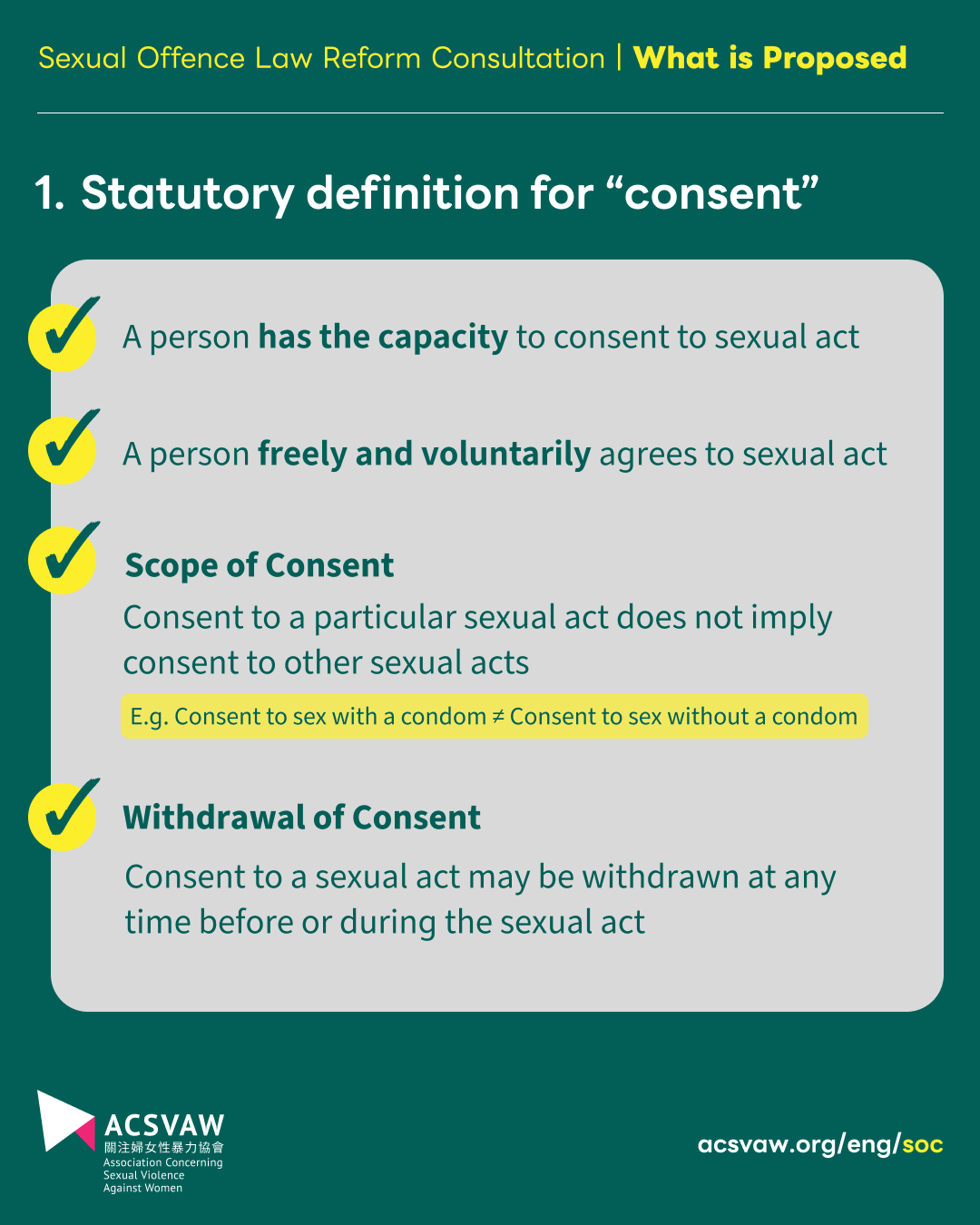
Establishing a Statutory Definition of Consent
The consultation paper proposes establishing a statutory definition of 'consent' and setting out provisions regarding its scope and withdrawal.
Statutory Definition of 'Consent'
A person consents to a sexual act if that person:
(a) has the capacity to consent to the sexual act; and
(b) freely and voluntarily agrees to the sexual act.
Scope and Withdrawal of 'Consent'
(a) consent to a particular sexual act does not imply consent to other sexual acts; and
(b) consent to a sexual act may be withdrawn at any time before or during the sexual act; if the relevant sexual act continues to take place after consent has been withdrawn, such a sexual act constitutes a 'non-consensual sexual offence'.
✔ Capacity to consent
Must possess the mental and physical capacity to give agreement.
✔ Freely and voluntarily given
Made without fear, pressure, or coercion.
✔ Specific
Agreement to one act does not imply consent to another
(e.g. consenting to sex with a condom ≠ consenting to unprotected sex)
✔ Revocable at any time
Consent can be withdrawn at any point before or during sexual activity
Made without fear, pressure, or coercion.
✔ Specific
Agreement to one act does not imply consent to another
(e.g. consenting to sex with a condom ≠ consenting to unprotected sex)
✔ Revocable at any time
Consent can be withdrawn at any point before or during sexual activity
Consent can be withdrawn at any point before or during sexual activity
🤔 Lack of resistance alone does not constitute consent must be added to the scope and withdrawal of consent
The law must explicitly address the harmful myth that a victim-survivor is expected to fight back during a sexual assault. This critical principle should not merely be relegated to the list of circumstances where consent is vitiated; rather, it must be prominently enshrined within the statutory definition of consent' itself.
Incorporate a specific provision within the scope of consent stating: A person who does not offer physical or verbal resistance to sexual conduct is not, by reason only of that fact, to be taken to consent to sexual conduct.
Examples from overseas jurisdictions:
- Canada Criminal Code, s265(3)
- New South Wales Crimes Act 1900, s61HI(4)
- Queensland Criminal Code 1899, s348(3)
- The Irish Criminal Law (Rape) (Amendment) Act 1990, s9(5)
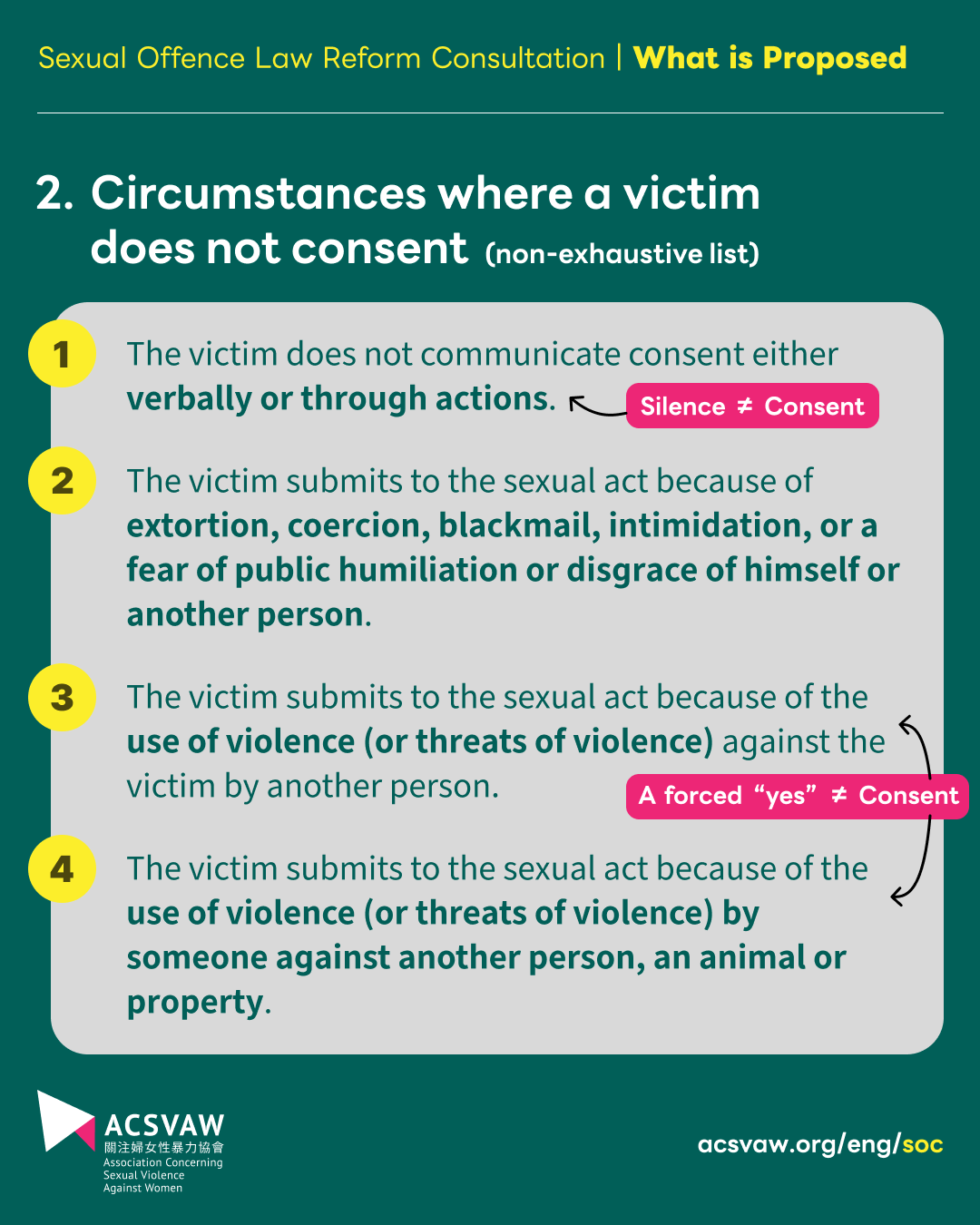
Listing Circumstances Where Consent is Vitiated (A Non-Exhaustive List)
The consultation paper proposes specifying a list of circumstances in the legislation where a victim does not consent.
When evidence establishes that the following circumstances exist at the time a sexual act occurs, a victim will be taken as not consenting to the sexual act since the victim lacks the capacity to consent to the sexual act, and/or does not freely and voluntarily consent to the sexual act. The circumstances include:
The victim does not communicate consent either verbally or through actions
The victim submits to the sexual act because of extortion, coercion, blackmail, intimidation, or a fear of public humiliation or disgrace of himself or another person
The victim submits to the sexual act because of the use of violence (or threats of violence) against the victim by another person
The victim submits to the sexual act because of the use of violence (or threats of violence) by someone against another person, an animal or property
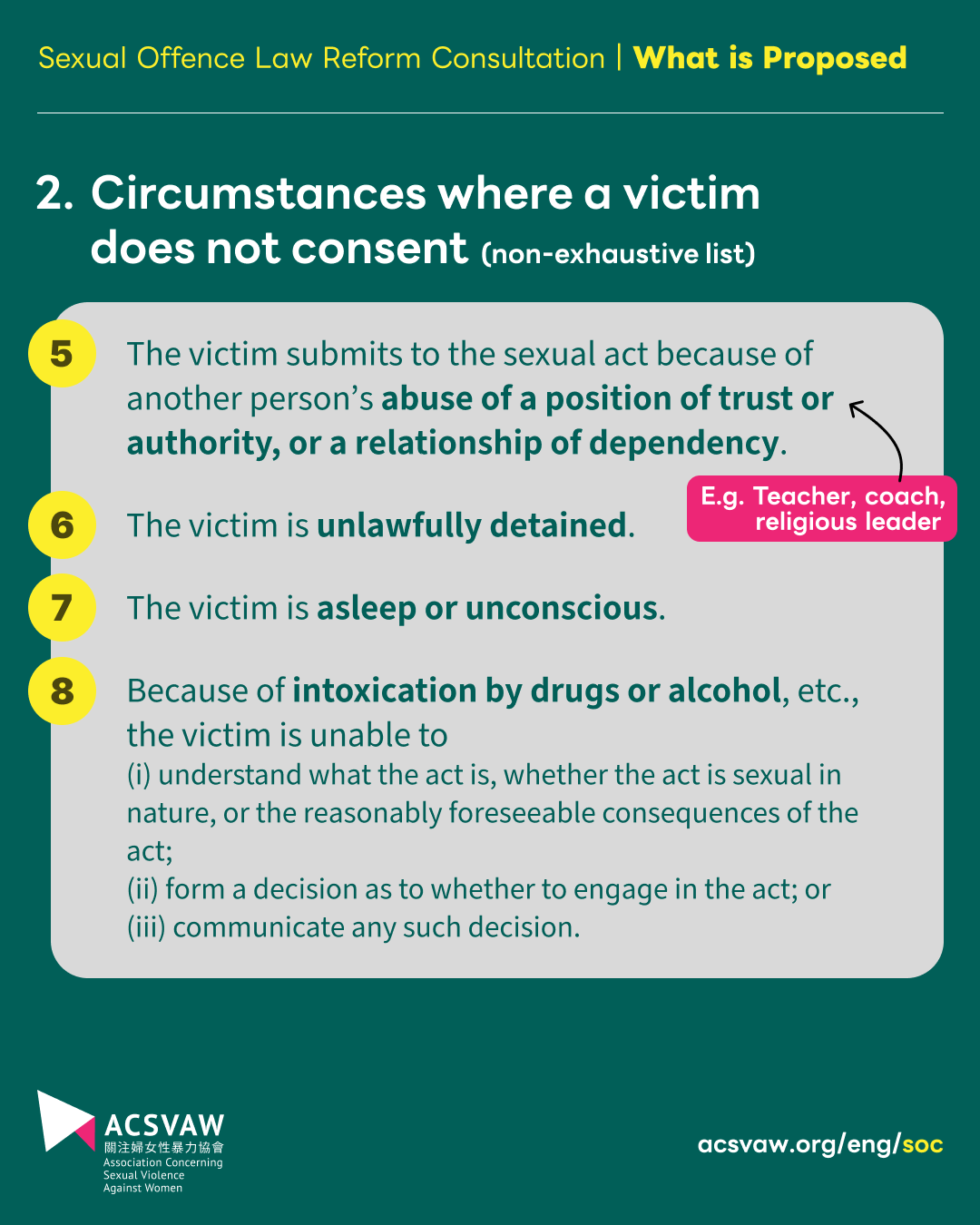
The victim submits to the sexual act because of another person's abuse of a position of trust or authority, or a relationship of dependency
The victim is unlawfully detained;
The victim is asleep or unconscious
Because of intoxication by drugs or alcohol, etc., the victim is unable to
(i) understand what the act is, whether the act is sexual in nature, or the reasonably foreseeable consequences of the act;
(ii) form a decision as to whether to engage in the act; or
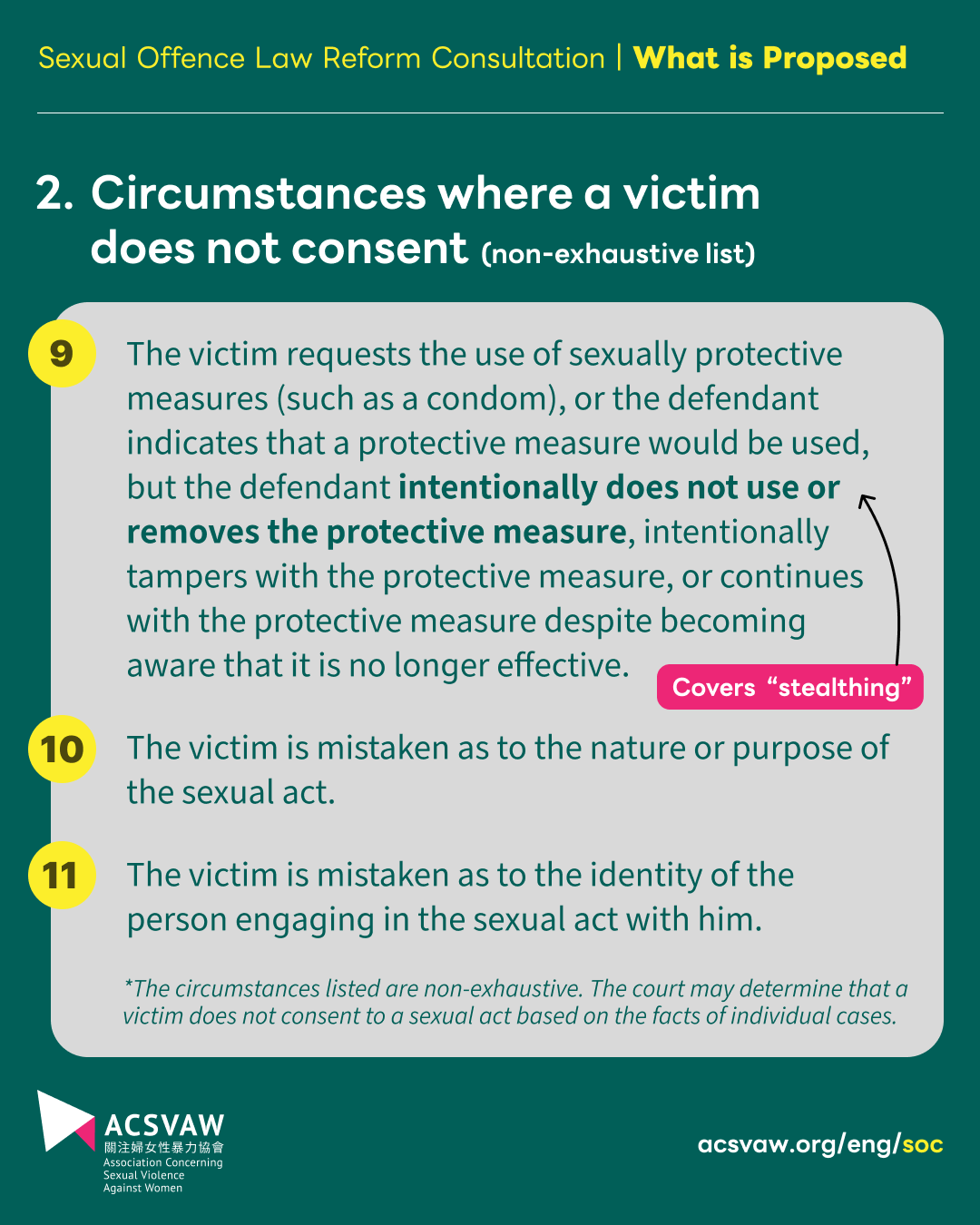
(iii) communicate any such decisionThe victim requests the use of sexually protective measures (such as a condom), or the defendant indicates that a protective measure would be used, but the defendant intentionally does not use or removes the protective measure, intentionally tampers with the protective measure, or continues with the protective measure despite becoming aware that it is no longer effective
The victim is mistaken as to the nature or purpose of the sexual act
The victim is mistaken as to the identity of the person engaging in the sexual act with him
*The circumstances where a victim does not consent are non-exhaustive. The court may determine that a victim does not consent to a sexual act based on the facts of individual cases.
✔ Helps victim-survivors validate their experiences and encourages them to seek help
✔ Assists supporters and law enforcement personnel in validating the experiences of those seeking help.
✔ Explicitly states that silence or submitting under coercion does not constitute consent
✔ Covers cases involving the abuse of a position of trust or authority (e.g. teachers, coaches, religious leaders)
✔ Covers "stealthing"
🤔 Addressing situations where an abuser indirectly obtains "consent" from a third party
- Example: An abuser finds someone online to assault their drugged, unconscious partner, falsely claiming to the third party that the partner had given prior consent.
Add the word "personally" to the proposed provisions
I.e. the victim must have personally expressed consent, and agreement cannot be expressed by the words or conduct of a person other than the complainant)Examples from overseas jurisdictions:
- Canadian Criminal Code s273.1(2)(a)
- Sexual Offences (Scotland) Act 2009 s13(2)(f)
- Ireland Criminal Law (Rape) (Amendment) Act, 1990 s9(2)
Survivor Perspectives
-
In court, A, the complainant in an indecent assault case, was repeatedly questioned by the defence: "Why didn't you scream for help?", "Why didn't you fight back fiercely?"
❝ "Why must I scream?" A countered. "Everyone reacts differently when faced with something like this. I scream when I see a cockroach, but that doesn't mean I will scream when I am being indecently assaulted by you... The defence has made an assumption that if a person is assaulted, they will definitely scream. Because I didn't scream, they conclude the incident never happened and that I am lying."
(Originally quoted in Cantonese)
-
"I've been on the police force for 30 years, a real rape isn't like this."
This was the assertion made by an officer after listening to Y's account when she went to report her assault. The police investigation was ultimately closed.
The police questioned why Y did not fight back fiercely. The female officer taking her statement remarked that if she ever encountered a similar situation, she would definitely hit the assailant, even demonstrating with a pushing gesture using her legs to show what "normally" ought to be done. Y found the line of questioning ludicrous. The perpetrator was taller, muscular, and far stronger than her. If she could not even push him away, how could she possibly win a physical fight against him?
❝ "Besides, if I hit him, wouldn't he hit me back? Would my life be in danger after I hit him? At that point, it might not just be a rape case—it could become rape and murder."
(Originally quoted in Cantonese)
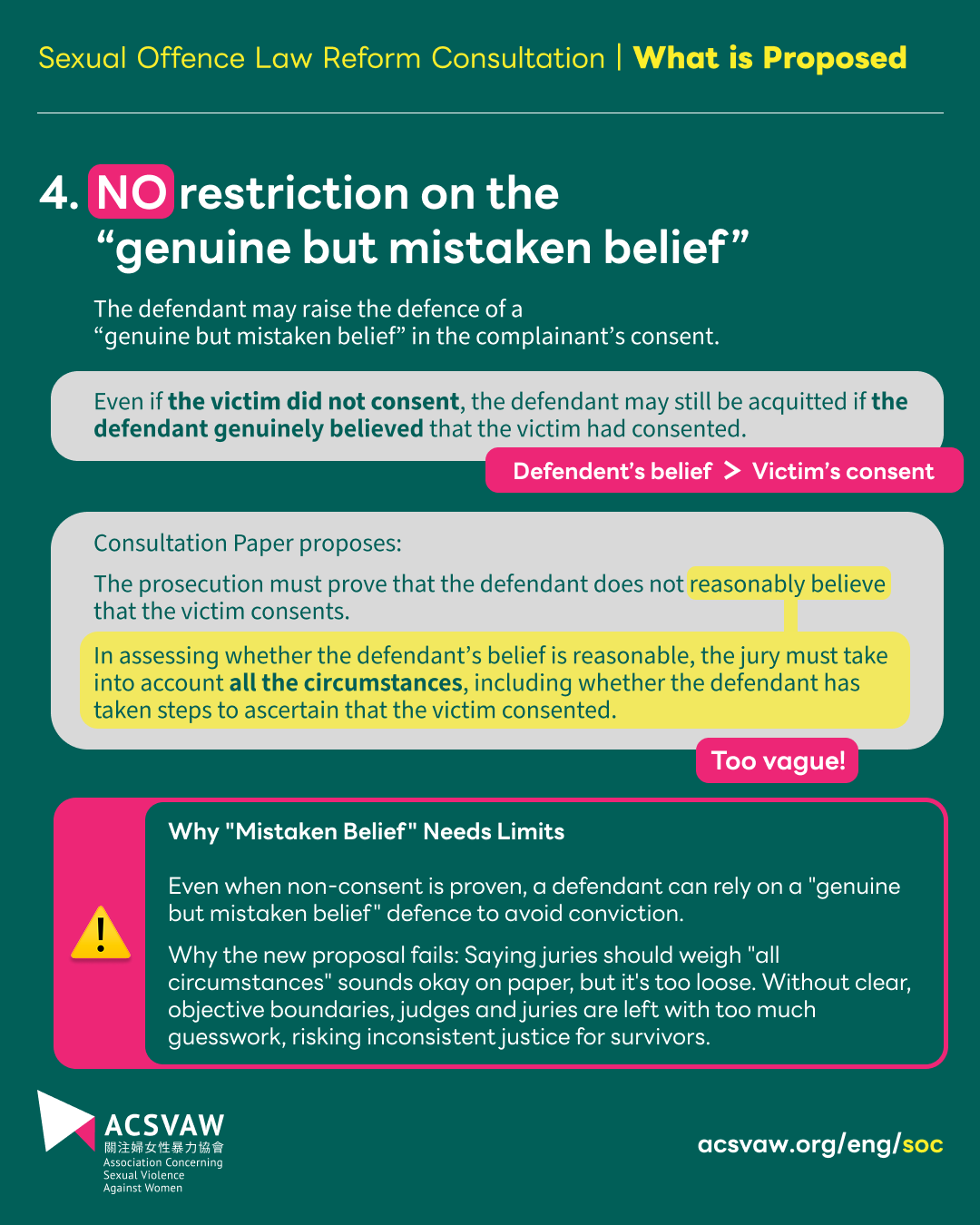
No Limitations Placed on the "Mistaken Belief in Consent" Defence
When assessing whether a defendant's belief in the victim's consent to sexual activity was reasonable, the jury must make a determination after considering all relevant circumstances, including whether the defendant took steps to ascertain whether the victim consented.
Failing to Limit the "Mistaken Belief" Defence Leaves a Loophole for Abuse
Regarding situations where a defendant claims an "honest but mistaken belief in consent", the consultation paper recommends referencing the English Sexual Offences Act 2003, proposing that whether the defendant's belief was reasonable should be determined by considering "all the circumstances".However, considering "all the circumstances" risks allowing subjective factors to be weighed, such as the defendant's failure to understand that "a lack of resistance does not equal consent" or their unilateral assumption that the victim was attracted to them, leading to the flawed conclusion that the defendant's "misunderstanding was reasonable". This fails to address the current issue where courts interpret trauma responses like freezing, submission, or a lack of physical resistance as circumstances created by the victim, falling short of the reform's original intent.
Multiple overseas law reform commissions and academic studies have pointed out that using the English 2003 model to handle "mistaken belief in consent" fails to achieve true law reform. For instance1, 2
- Scotland (2007): The Scottish Law Commission noted that this approach bears no significant practical difference from the original subjective test.3
- Ireland (2019): The Law Reform Commission of Ireland highlighted that such an approach risks undermining the proposed objectively-led standard by reintroducing a substantial subjective element.4
In New South Wales, Australia, legal practice saw cases where a defendant fulfilled the requirement of taking "steps" based purely on internal inferences, without needing to demonstrate any outward communication or concrete action (R v Lazarus [2017] NSWCCA 279). The statutory wording in NSW at the time was extremely similar to what the current consultation paper proposes. Such vague phrasing allows trials to focus excessively on scrutinising whether the victim's words or conduct caused a "misunderstanding", while allowing the defendant's myths and misconceptions to dominate the assessment of "reasonableness", failing to introduce a genuinely objective element into the legal test.
1. Clarifying the Defendant's Active Duty to Ascertain Consent
To fulfill the legislative objective, the statutory provision must emphasise that the purpose of any action taken by the defendant is to facilitate active communication regarding consent. Therefore, the Association recommends drafting the provision as follows:- Whether a belief is reasonable is to be determined having regard to anything the accused said or did to ascertain whether the complainant consented. An act is not done to ascertain consent if it does not invite the complainant's communication to give, withdraw or refuse consent.
2. Barring the "Mistaken Belief in Consent" Defence Under Specific Circumstances
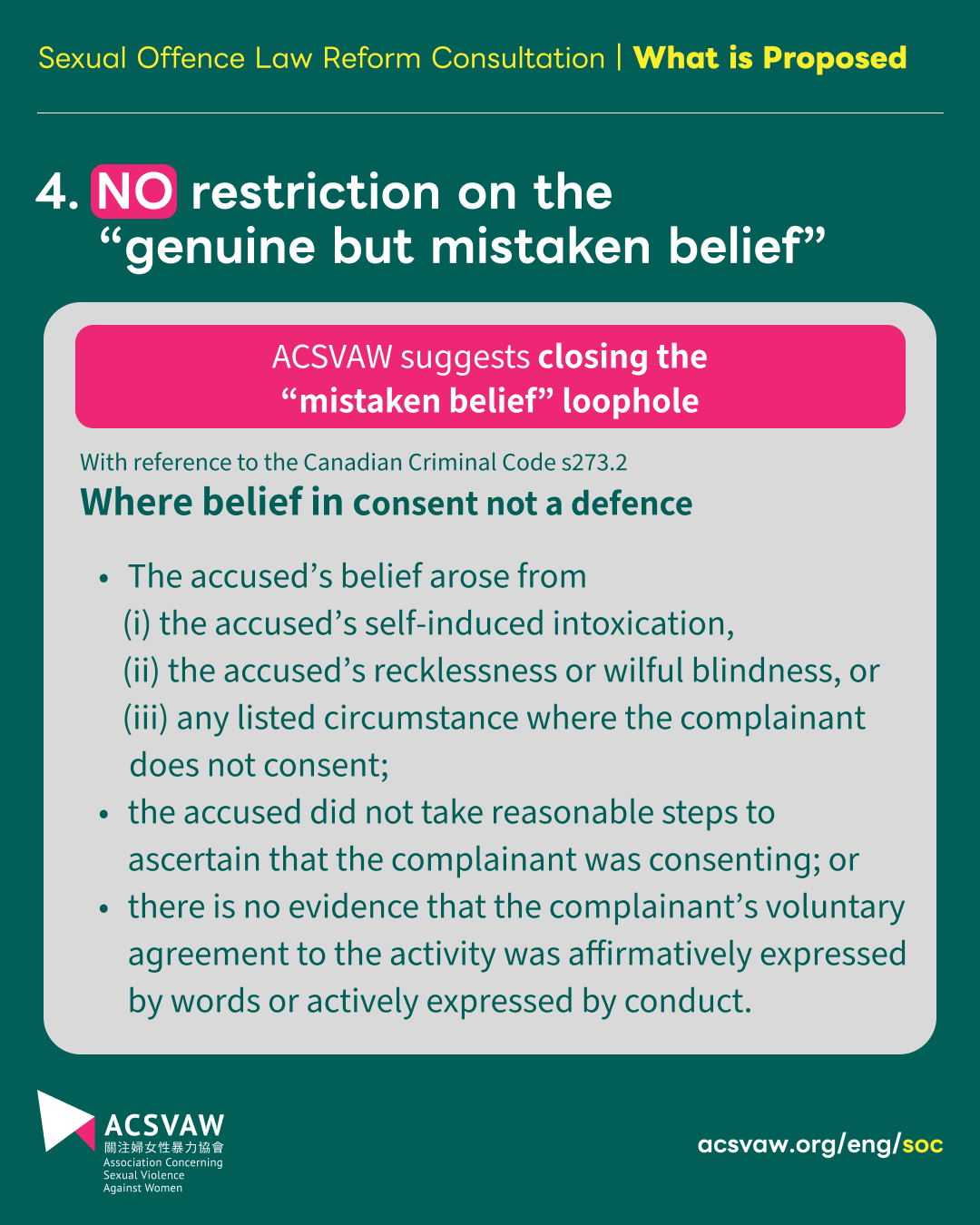
Referencing the limiting provisions in Section 273.2 of the Canadian Criminal Code, the law should explicitly specify that a defendant cannot raise the defence of "mistaken belief in consent" where their belief arose from:
- The accused's self-induced intoxication (e.g. through alcohol or drugs)
- The accused's recklessness or wilful blindness
- Any circumstance specified in the non-exhaustive list of "circumstances where a victim does not consent"
- The accused failing to take reasonable steps to ascertain the complainant's consent; or
- An absence of evidence showing that the complainant affirmatively expressed voluntary consent by words or conduct
Canada has implemented these provisions since 1992 without compromising judicial fairness. This approach ensures that a victim's natural trauma responses, such as freezing or being unable to resist during an assault, can no longer be weaponised by perpetrators as an excuse to evade criminal liability in court.
1. Finch E. & Munro V.E. (2006). "Breaking boundaries - Sexual consent in the jury room". Legal Studies. Vol 26(3). pp.303-320.
2. Carline, A. & Gunby, C. (2011). "'How an Ordinary Jury Makes Sense of it is a Mystery': Barristers' Perspectives on Rape, Consent and the Sexual Offences Act 2003". Liverpool Law Review. Vol 32(3). pp.237-250.
3. Scottish Law Commission. (2007). Report on Rape and Other Sexual Offences (No 209). p.56.
4. Ireland Law Reform Commission. (2019). Report: Knowledge or Belief Concerning Consent in Rape Law (LRC 122-2019). p.68.
Survivor's Perspectives
-
Martian (pseudonym) was persistently sexually abused by her teacher during secondary school. Because some of the assaults occurred after she turned 16, if the defendant could show a possibility of honestly believing she consented to the sexual acts, the judge would be required to acquit him. Yet in her experience, these were not isolated incidents of sexual assault; rather, they were rooted in the perpetrator's long-term sexual grooming of a child through the abuse of a position of trust and power imbalance...
❝ It wasn't that I didn't say no—it was why I was unable to say no.
She believes it is entirely unreasonable to place the burden of refusal on the victim...
❝ Instead of asking the perpetrator why he did this, you ask me why I didn't leave. The whole thing is completely backwards.
❝ A healthy society shouldn't teach children how to refuse every adult who crosses the line; instead, it should ensure every adult knows that crossing the line is unacceptable.
❝ When I look back on what happened, I feel there were so many grey areas. It felt as though he really could just claim he misunderstood, leaving me feeling that there was simply no way to prevent something like this from happening again.
❝ That was until I heard about the concept of 'Affirmative Consent'. I saw on social media that certain Australian states clarify the definition of 'consent' in their laws, explicitly stating that the initiating party must not presume consent and bears the responsibility to ensure they have received freely given, voluntary consent before engaging in a sexual act. When I saw it spelled out like that in law, I finally realised it could actually be done—that there is a way forward.
(Originally quoted in Cantonese)
-
❝ When I look back on what happened, I feel there were so many grey areas. It felt as though he really could just claim he misunderstood, leaving me feeling that there was simply no way to prevent something like this from happening again.
❝ That was until I heard about the concept of 'Affirmative Consent'. I saw on social media that certain Australian states clarify the definition of 'consent' in their laws, explicitly stating that the initiating party must not presume consent and bears the responsibility to ensure they have received freely given, voluntary consent before engaging in a sexual act. When I saw it spelled out like that in law, I finally realised it could actually be done—that there is a way forward.
(Originally quoted in Cantonese)
-
A friend X had known for years took advantage of her intoxication and sexually assaulted her without her consent.
During the trial, the defence argued that she held liberal views on sex, had discussed sexual topics with the defendant on WhatsApp prior to the incident, had invited the defendant home for drinks, and offered no resistance—claiming these factors led the defendant to mistakenly believe X consented to sexual activity.
❝ "I stated that there was absolutely no misunderstanding; I definitely did not consent, because he and I were strictly friends. The defence was simply trying to frame it as though I enticed him and that my character was flawed."
X found these lines of questioning absurd.
❝ "My character and what happened—whether or not I consented—are two completely different things. You should be asking about consent; we are talking about rape here."
❝ "If you only look at it as 'because you brought him home at the time, that meant you were willing', then what is the point of a trial? There would be no need for one at all. It's just a waste of government resources and public funds."
If her experience had occurred in Canada, because it falls under the circumstance of "the victim being under the influence of alcohol or drugs", the defendant would be legally barred from raising the defence of an "honest but mistaken belief in consent".
(Originally quoted in Cantonese)
-
Survivor J agrees that sexual offence legislation should explicitly specify that the party initiating a sexual act has a proactive responsibility to ascertain sexual consent.
❝ Even putting myself in the shoes of the initiating party, it's something I would want to do. Confirming consent beforehand seems like a sensible way to avoid 'misunderstandings' or 'accidentally facing prosecution'.
(Originally quoted in Cantonese)
Sexual Assault
Expanding the Offence of "Rape" to Cover Penetrative Sexual Assault
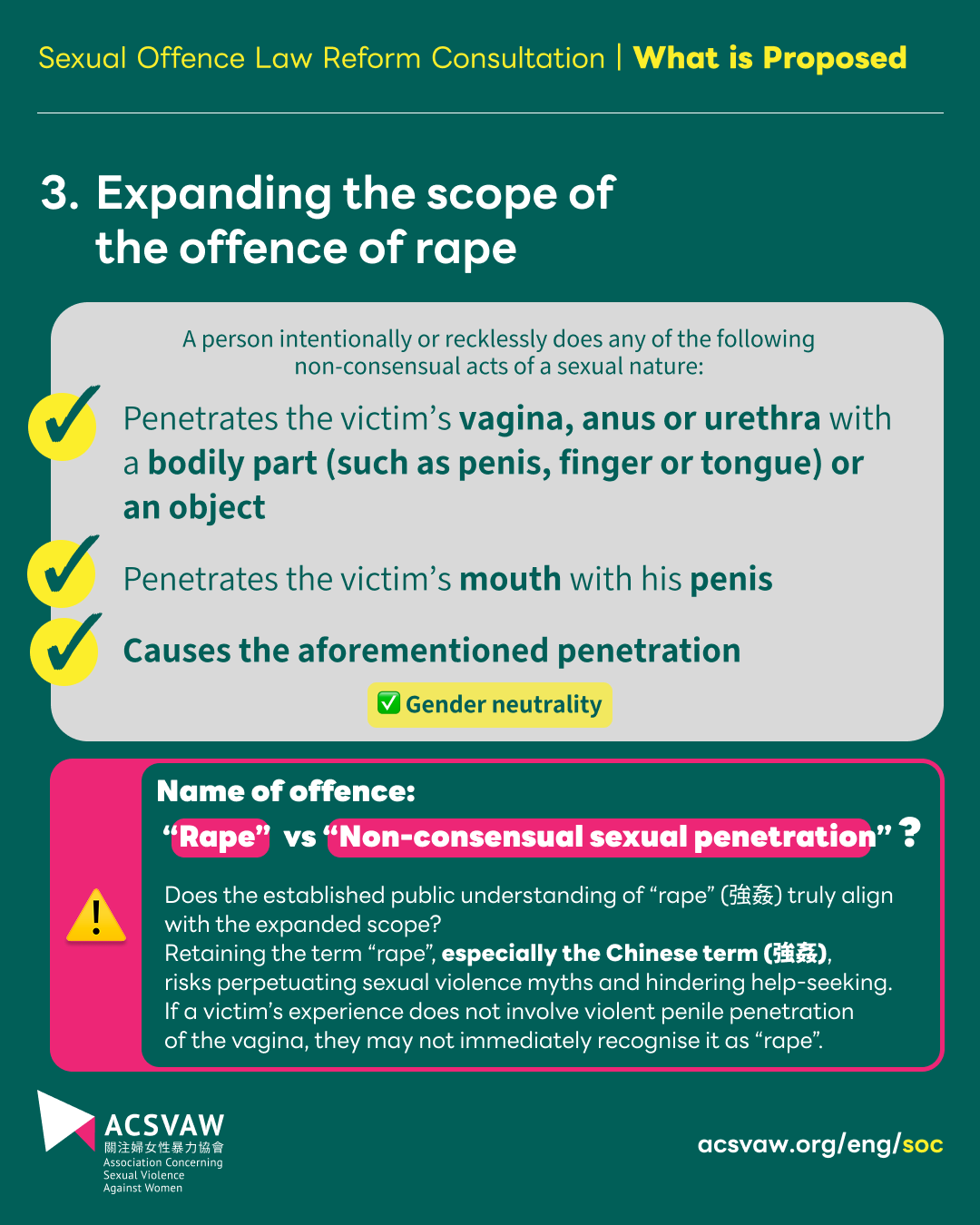
The consultation paper proposes amending the offence of "rape", expanding its scope from penile-vaginal penetration to cover a broader range of penetrative sexual assaults.
A person intentionally or recklessly engages in any of the following non-consensual acts of a sexual nature:
(a) Penetrating the victim's vagina, anus, or urethra with a body part (such as a penis, finger, or tongue) or an object;
(b) Penetrating the victim's mouth with a penis;
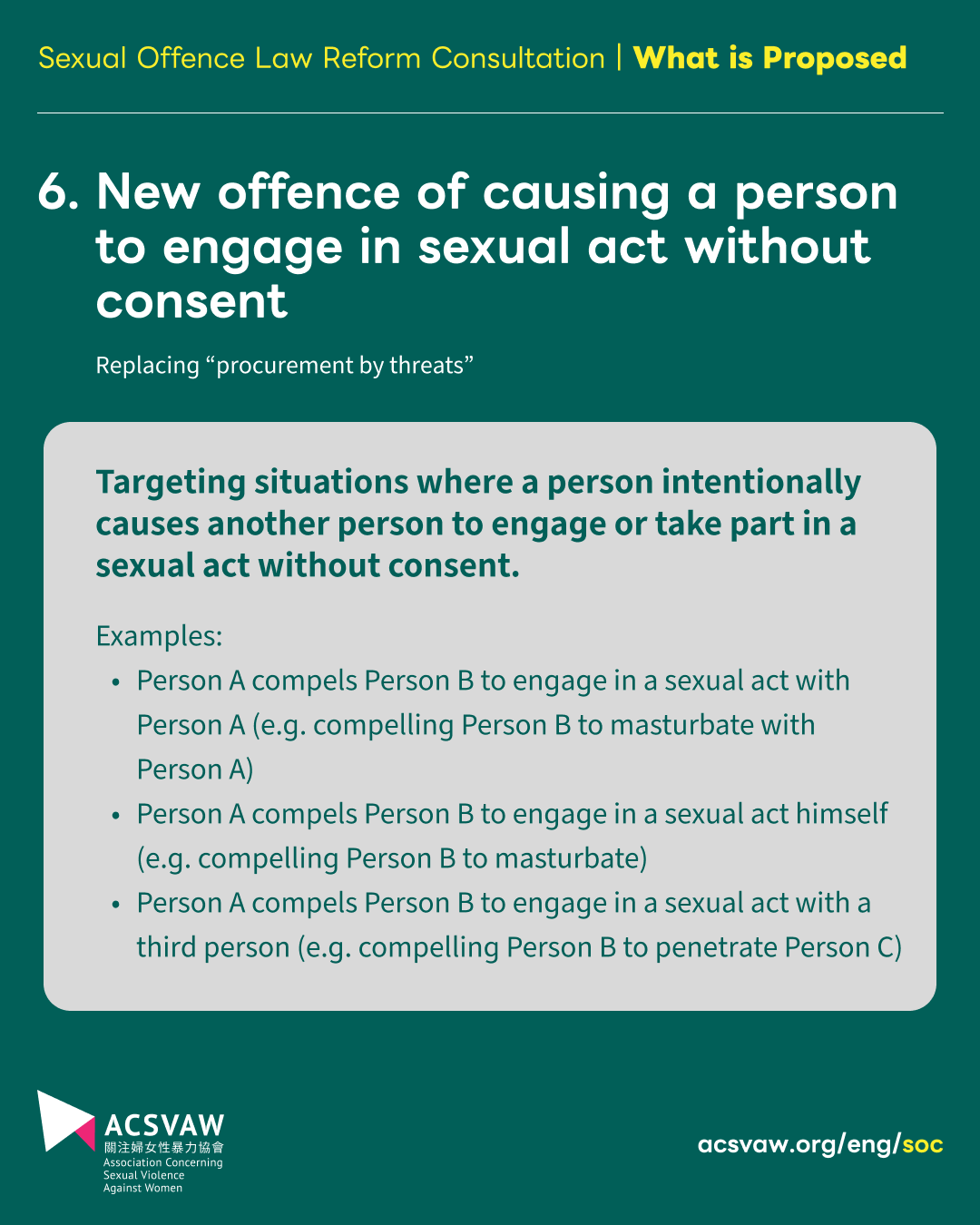
(c) Compelling the aforementioned penetration.
✔ Covers forms of penetrative sexual assault beyond vaginal intercourse (which currently can only be charged under the lesser offence of indecent assault)
✔ Provides fuller protection for male and transgender victim-survivors.
🤔 Retaining the term "rape", especially the Chinese term (強姦), risks perpetuating sexual violence myths and hindering help-seeking
It easily leads to the misconception that the assault must involve physical force or physical resistance.
- Defendants have previously argued in court that an intoxicated victim's lack of resistance implied consent, claiming the incident was therefore not "rape" (強姦).
- Victim-survivors who submitted under coercion have shared when seeking help that because their experience did not involve physical violence or resistance, they initially failed to recognise that they had experienced "rape" (強姦).
It is easily perceived as an offence involving only female victims or penile penetration
- Newly protected victim-survivors may struggle to immediately connect their experience to the legal definition.
- If an incident does not match public stereotypes of physical force or female-only victimisation, survivors may mistakenly believe their experience is not covered by the law, thereby weakening their willingness to seek help and report to the police
💭 Rename the offence of penetrative sexual assault to "Sexual Penetration Without Consent" (未經同意下的性插入)
More precise terminology will immediately enhance public understanding of the new legislation.
- The title should clearly convey the legislative intent of centering consent, while emphasising that all forms of penetrative sexual acts are covered.
- The legal title of an offence in legislation does not restrict everyday language (for instance, the offence of "indecent assault" is commonly referred to as "非禮" in daily usage).
Survivor Perspectives
-
❝ Even after I was raped, I didn't realise that what happened to me constituted rape.
S was sexually assaulted after meeting someone she met on a dating application, involving penile-vaginal penetration. Initially, however, she did not realise that her experience was actually 'rape', so the thought of reporting it to the police never even crossed her mind.
❝ Before going through something like this, people usually think that rape only means being dragged into a dark alleyway or being attacked by notorious serial predators like the 'Tuen Mun Rapist' (屯門色魔).
❝ Regarding the naming of the offence of 'rape', the consultation paper proposes retaining the term on the grounds that it is widely recognised by society, and changing it might lead the public to misinterpret the offence as less severe. But for survivors, the word 'rape' itself acts as a barrier. Many people immediately assume that rape must involve strangers, explicit physical violence, or being dragged into a dark alleyway. Taking myself as an example, it took me several years to come to terms with the fact that what I went through was actually rape, simply because my perception of 'rape' was entirely different from what I experienced. I am certain I am not the only person who has held this doubt: 'Does this word describe what happened to me? Is my experience protected by the law?'"
❝ One of the core principles laid down by the government in this reform is to make the elements of offences clearer. Yet following the amendment, the legal substance of 'rape' will have completely changed—encompassing various forms of penetration, applying to any gender, and shifting its core focus from violence to 'consent' and sexual autonomy. Retaining a word whose legal definition has changed while public perception remains outdated directly contradicts this principle. While we understand the government's concern that renaming the crime might make it seem less serious, continuing to use a term that evokes an outdated, narrow definition similarly creates ambiguity around the elements of the offence.
(Originally quoted in Cantonese)
-
❝ Regarding the naming of the offence of 'rape', the consultation paper proposes retaining the term on the grounds that it is widely recognised by society, and changing it might lead the public to misinterpret the offence as less severe. But for survivors, the word 'rape' itself acts as a barrier. Many people immediately assume that rape must involve strangers, explicit physical violence, or being dragged into a dark alleyway. Taking myself as an example, it took me several years to come to terms with the fact that what I went through was actually rape, simply because my perception of 'rape' was entirely different from what I experienced. I am certain I am not the only person who has held this doubt: 'Does this word describe what happened to me? Is my experience protected by the law?'
❝ One of the core principles laid down by the government in this reform is to make the elements of offences clearer. Yet following the amendment, the legal substance of 'rape' will have completely changed—encompassing various forms of penetration, applying to any gender, and shifting its core focus from violence to 'consent' and sexual autonomy. Retaining a word whose legal definition has changed while public perception remains outdated directly contradicts this principle. While we understand the government's concern that renaming the crime might make it seem less serious, continuing to use a term that evokes an outdated, narrow definition similarly creates ambiguity around the elements of the offence.
(Originally quoted in Cantonese)
Sexual Assault "Involving Touching" and
Sexual Assault "Without Touching"
The consultation paper proposes replacing "indecent assault" with "sexual assault involving touching", alongside introducing a new offence of "sexual assault without touching".
The creation of "sexual assault without touching" aims to address non-contact sexual violence scenarios that were previously prosecutable under "indecent assault", but would fall outside the scope of "sexual assault involving touching".
Sexual Assault Involving Touching
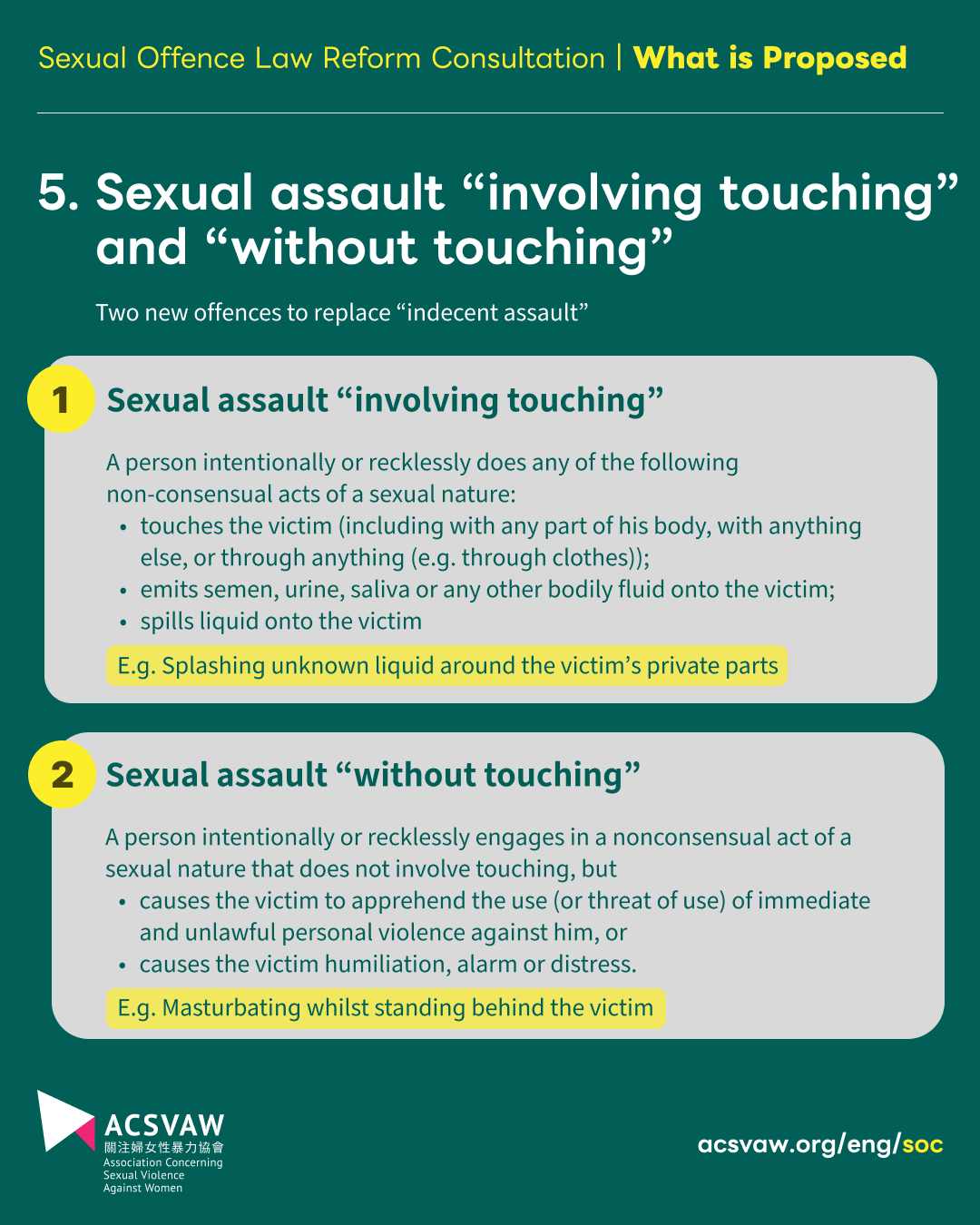
A person intentionally or recklessly engages in any of the following non-consensual acts of a sexual nature:
(a) Touching the victim (including with any part of their body, with anything else, or through an object (e.g. through clothes));
(b) Emitting semen, urine, saliva, or any other bodily fluid onto the victim;
(c) Splashing liquid onto the victim.
Sexual Assault Without Touching
A person intentionally or recklessly engages in a non-consensual act of a sexual nature that does not involve touching, but causes the victim to apprehend the use (or threat of use) of immediate and unlawful personal violence against them, or causes the victim humiliation, alarm, or distress.
✔ Covers the recent concerning sexual violence trend of splashing unknown liquids onto intimate body parts.
✔ Shifts the focus of the offence from "indecency" (a concept tied to public morality) to "sexual nature", thereby upholding personal sexual autonomy.
✔ Targets non-contact acts currently covered by "indecent assault" that cause a victim to apprehend immediate and unlawful physical violence (e.g. masturbating in front of another person).
🤔 Can "sexual assault without touching" effectively cover non-contact sexual violence behaviours that were previously left unaddressed?
- A perpetrator repeatedly going to a victim's residence to smell their underwear and shoes.
- A perpetrator stalking a victim on the street while persistently making unwelcome sexual advances.
- A perpetrator sending non-consensual images of their genitalia alongside sexually suggestive text to a victim via messaging applications, intended to cause offence and humiliation.
Child Sexual Offences
Addressing Prosecutorial Loopholes in Persistent Child Sexual Abuse
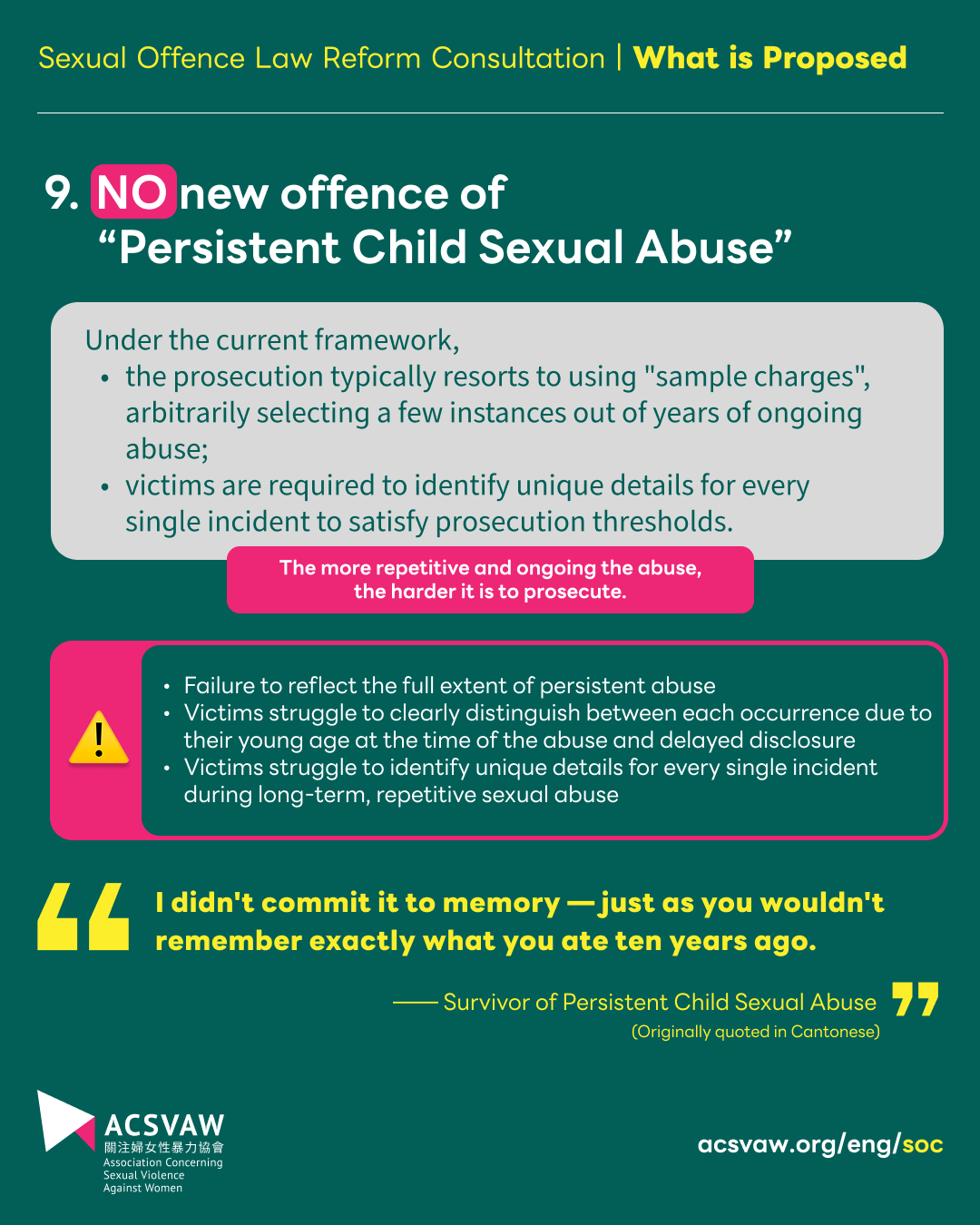
The consultation paper fails to propose reform options to address the widespread and severe predicament of "Persistent Child Sexual Abuse". The current framework fails to tackle a critical prosecutorial loophole: the more repetitive and prolonged the abuse, the less able a victim is to distinguish the specific details of each assault, making it increasingly difficult to prosecute and convict the perpetrator.
Perpetrators who persistently abuse child victims are overwhelmingly adults with whom the child has a close relationship. Most commonly, abusers exploit trust and authority to force compliance and secrecy, making delayed disclosure an extremely prevalent phenomenon. Between 2019 and 2023, RainLily received nearly 500 requests for assistance involving childhood sexual abuse, 55.9% of which involved repeated acts of sexual violence.
The Issue: The More Repetitive and Ongoing the Child Abuse, the Harder It Is to Prosecute
Prosecutorial LimitationsIn cases of repeated sexual assault, the prosecution typically resorts to using "sample charges", arbitrarily selecting a few instances out of years of ongoing abuse to bring forward charges. Expecting a victim to precisely differentiate the specific facts and dates for each individual charge places an unrealistic and unreasonable burden on them.
Unreasonable Evidential Burdens
Under long-term, repetitive sexual abuse, victims are required to identify unique details for every single incident to satisfy prosecution thresholds. Constrained by their young age at the time of the abuse and delayed disclosure, victims struggle to clearly distinguish between each occurrence. As a result, many cases are difficult to prosecute under existing laws or are downgraded to lesser offences.
Failure to Reflect the Full Extent of Persistent Abuse
Another limitation of sample charges is that a defendant's uncharged inappropriate acts are generally inadmissible in court; even if mentioned in the victim's statement, they are excised. Even if a conviction is ultimately secured, the court can only sentence the offender based on those few sample charges. This falls vastly short of the survivor's true experience of enduring dozens or hundreds of assaults, meaning the sentence fails to reflect the perpetrator's actual culpability and the true gravity of persistent abuse.
Establish a New Offence of "Persistent Child Sexual Abuse"
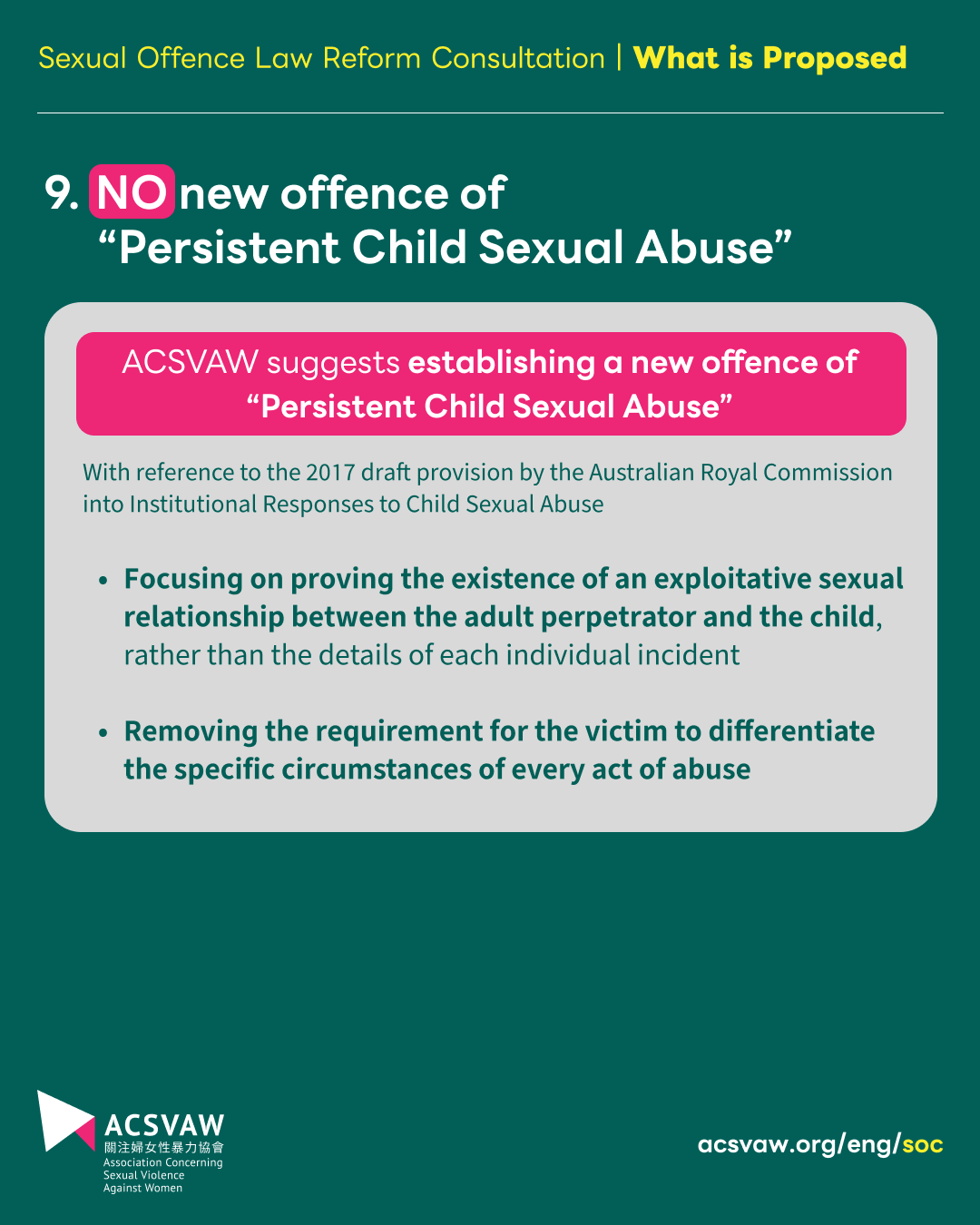
We urge the government to establish a dedicated offence of "Persistent Child Sexual Abuse", drawing reference from the model provisions recommended by the Australian Royal Commission into Institutional Responses to Child Sexual Abuse (see our position paper, Establishing a New Offence Against Persistent Child Sexual Abuse).
Survivor Perspectives
-
Bobo (pseudonym) was sexually abused by a family member from primary school through to secondary school, only reporting the crimes to the police after reaching adulthood and gaining her independence. The police recorded only four specific time points: the first incident, the last incident, the most vivid incident, and the incident that differed most from all the others. During her testimony, she was required to detail the exact year, month, day, location, and specific physical movements for each.
❝ Let me ask you: how many times did you eat at Café de Coral when you were little? Assuming you went every week, do you remember what meal you ordered or what drink you had every single time?
Bobo believes that when victim-survivors face long-term and frequent sexual abuse, the acts inevitably blur together in their memory. Expecting a survivor to clearly recall the details of every assault and demonstrate the 'uniqueness' of each incident places an impossible demand on them. She describes recalling childhood trauma as dealing with fragmented memories, much like the trivial details of daily life: "It is so hard to think back clearly; your body simply doesn't allow you to remember everything," and "you don't want to remember it again anyway."
Survivors of persistent childhood sexual abuse cannot control how trauma alters their memory, yet the courts treat them as unreliable witnesses. Bobo reflects that even if she had reported the abuse as a child, under the current approach of using 'sample charges', she does not believe her case would have had a high chance of conviction.
❝ So many cases end up the same way: a child is put on the witness stand and subjected to endless questioning. The child gets upset, cries, and becomes emotionally overwhelmed. Then they are accused of giving inconsistent statements, and the defendant is acquitted. Once the trial is over, there is no second chance. For the rest of her life, she will constantly blame herself, asking: 'Why wasn't I good enough? Why didn't I speak clearly back then, allowing him to walk free?'
-
Mui (pseudonym) was sexually abused by her stepfather from the age of 13. Over seven years, she endured more than 100 instances of persistent sexual abuse, which in court were reduced to just five charges: two counts of indecent assault, two counts of rape, and one count of indecent conduct towards a child under 16. A seven-person jury convicted her stepfather on four counts (one count of rape, two counts of indecent assault, and one count of indecent conduct) and acquitted him on the other rape charge. Mui felt that the court completely failed to capture the full reality of what happened.
❝ When people read the news, they just think he did those few things to me when I was young and stopped when I grew up. It feels like so much was left unsaid, stuck inside me.
When taking her statement, the police demanded that she specify whether penetration occurred, how she was sexually abused, the exact dates and locations of the rapes, and precise details of the physical movements. Being repeatedly pressed by officers for every location, every time, and every action brought her to tears and caused her intense distress.
❝ Looking back after seven years, it is so hard to recall every single date... Recalling it makes it feel so immediate, as if I am merging back into my past self, returning to that moment… feeling like it just happened yesterday.
However, not all details or experiences were included in her official statement; only explicitly unlawful acts of a 'sexual' nature were recorded. When she explained that refusing his advances led to beatings, verbal abuse, and mistreatment, officers dismissed these details as irrelevant to the 'sexual' charges and omitted them. Yet to Mui, enduring long-term verbal and physical aggression was deeply traumatic in itself: "Sexual violence doesn't just happen out of nowhere as a sudden ambush."
Out of more than a hundred assaults, the prosecution ultimately selected five 'discrete' incidents to prosecute. Ah Mui stresses that the long-term abuse she suffered simply cannot be quantified, and the perpetrator's non-sexual verbal and physical violence was completely unreflected by the charges.
In court, her memory of the finer details was repeatedly challenged. The judicial process fixated on minor technicalities rather than revealing the full narrative of what happened and the cumulative harm she endured over many years.
❝ Going to court should be about addressing the whole situation, not being... If I got a date or a number wrong, I was immediately labelled a dishonest person.
She shared that neither the police statements nor the court verdict helped her family understand the full picture. Even after the verdict, she continued to face doubt from her mother. She describes the entire experience as secondary trauma:
❝ Why did it have to be like this? I was genuinely harmed by someone, but [going to court] turned into a source of overwhelming pressure for me.
Age of Consent
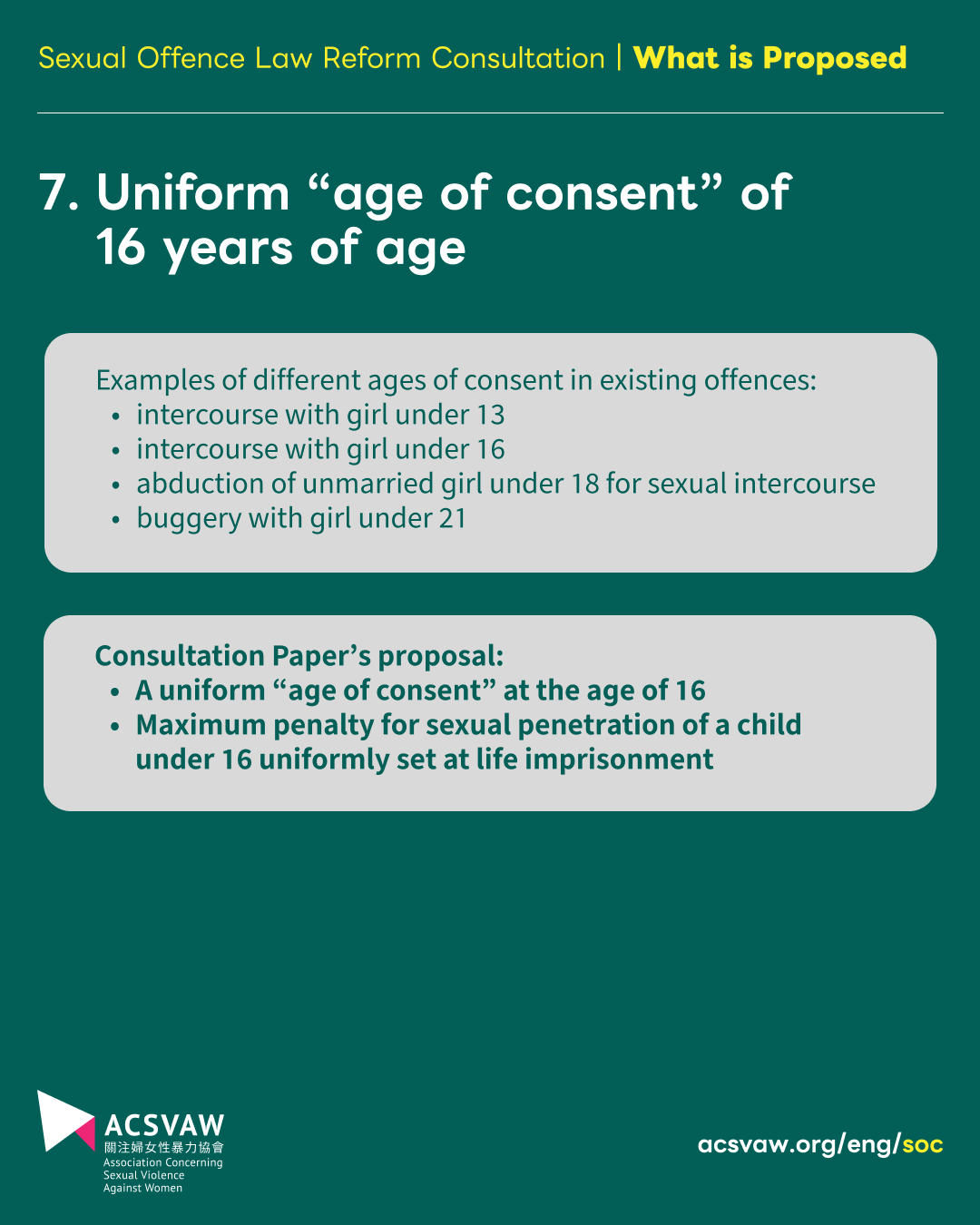
The consultation paper proposes continuing to adopt 16 as the "age of consent" in Hong Kong. In the past, differing ages of consent across genders and sexual acts carried risks of legal challenges, with certain provisions previously declared unconstitutional by the courts.
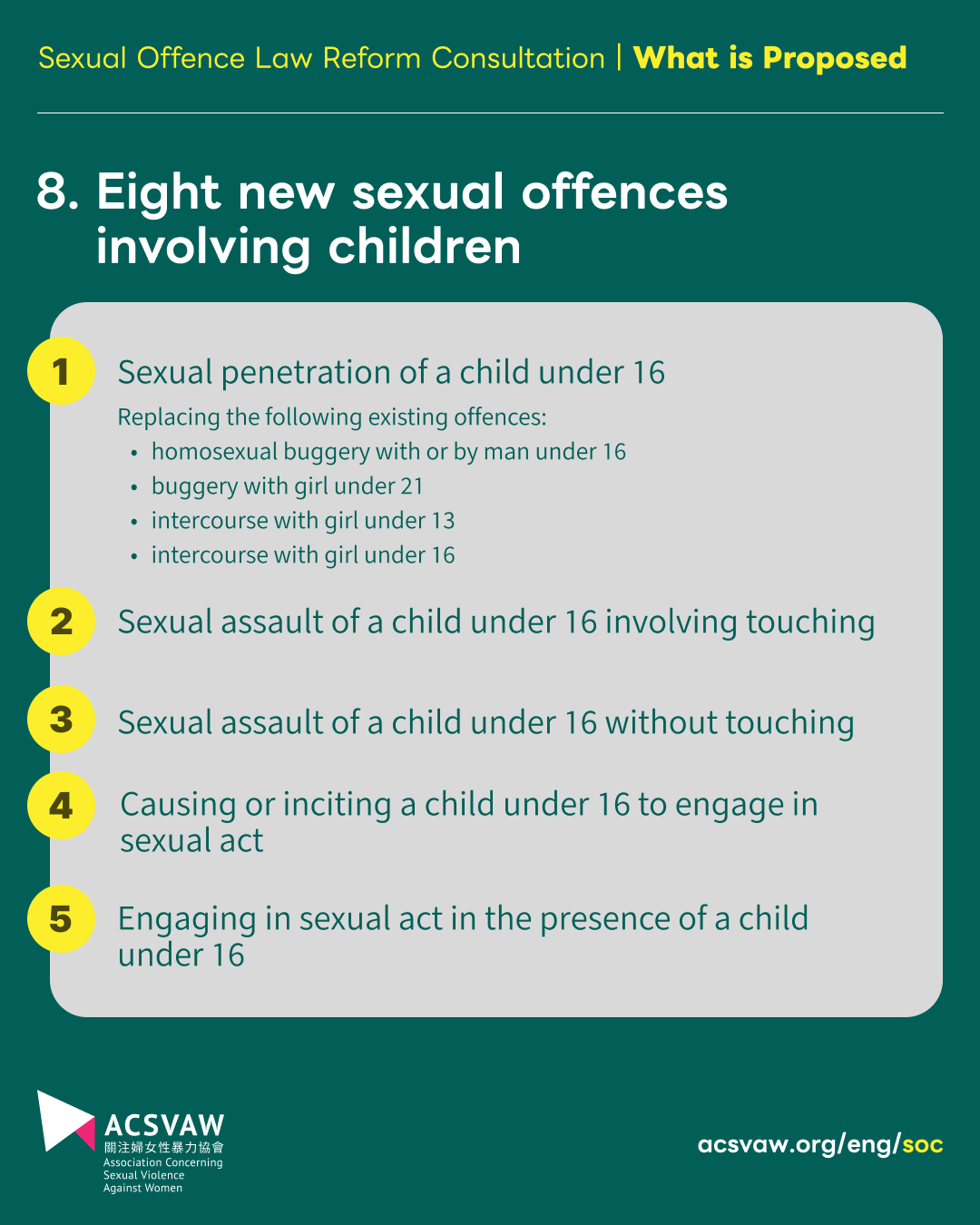
The consultation paper proposes amending existing provisions and introducing a range of new offences relating to individuals under 16, alongside their maximum penalties:
- Sexual penetration of a child under 16 | Life imprisonment
- Sexual assault of a child under 16 involving touching | Imprisonment for 14 years
- Causing or inciting a child under 16 to engage in sexual activity | Life imprisonment if a penetrative act is involved; otherwise, imprisonment for 14 years
- Engaging in a sexual act in the presence of a child under 16 | Imprisonment for 10 years if the victim is under 13; otherwise, imprisonment for 5 years
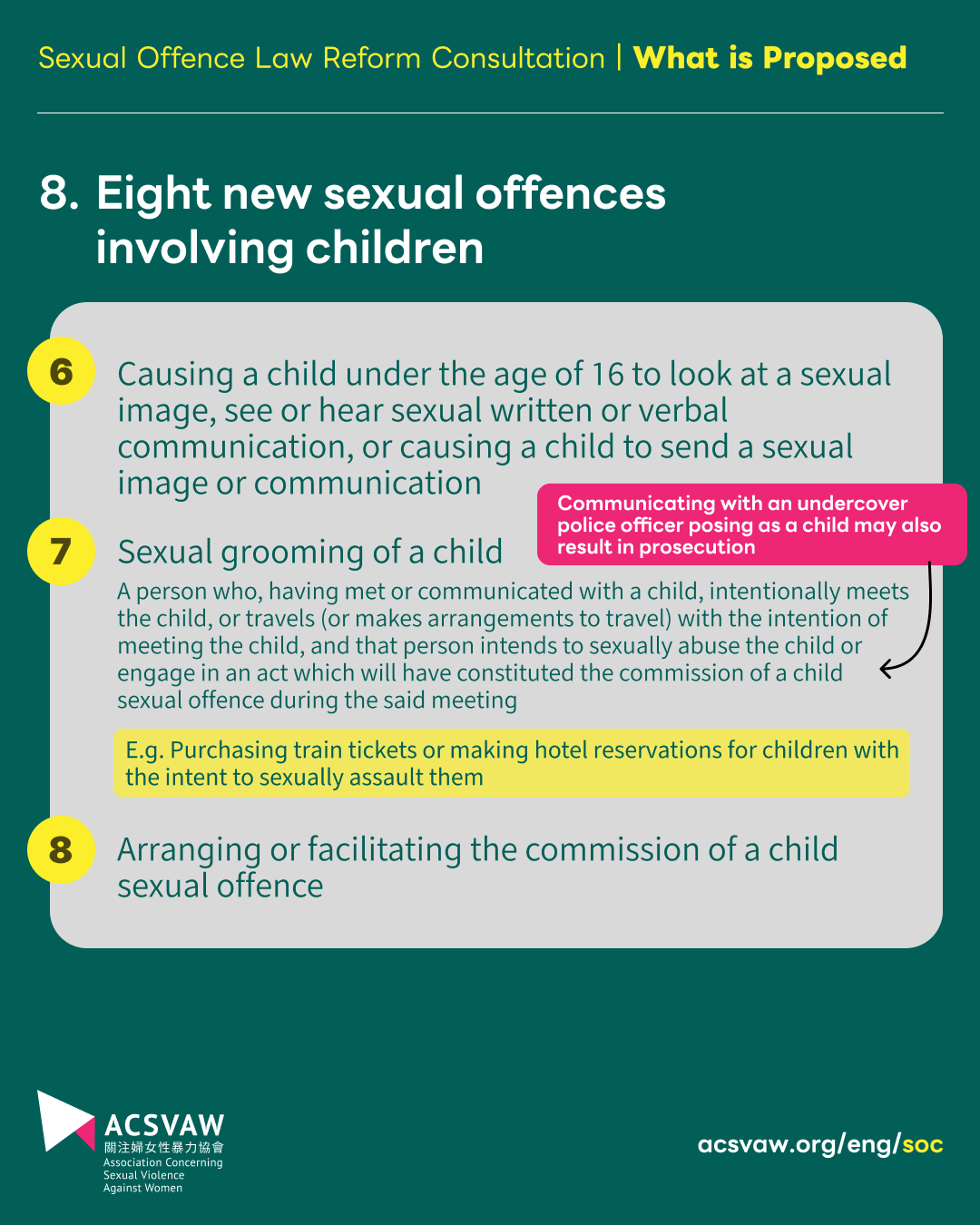
- Causing a child under 16 to look at a sexual image, see or hear sexual written or verbal communication, or causing a child to send a sexual image or communication | Imprisonment for 10 years if the victim is under 13; otherwise, imprisonment for 5 years
- Sexual grooming of a child | Imprisonment for 10 years
- Arranging or facilitating the commission of a child sexual offence | Equivalent to the maximum penalty for the principal child sexual offence involved
✔ Expands protection beyond vaginal and anal intercourse: Compared to current offences that only cover vaginal and anal intercourse, the proposed offence of "sexual penetration of a child under 16" further encompasses oral sex and penetration with objects.
🤔 Considering the impact of various offences on mutual sexual interactions between young peers
When young people (particularly those aged 14 to 15) face challenges regarding sexual health or sexual violence, there is a concern that fear of criminal liability may prevent them from seeking timely help from professionals, thereby undermining the original protective intent.
Adolescents often begin exploring their sexuality between the ages of 13 and 15. Mutual, non-violent sexual interactions with peers during this developmental stage cannot simply be eradicated through criminal law. According to the Youth and Sex Study published by The Family Planning Association of Hong Kong in 2021, among surveyed Secondary 3 to Secondary 6 students, 4.2% of females and 5.7% of males reported having engaged in sexual intercourse. For those with sexual experience, the average age of first sexual intercourse was 14.2 years for females and 15.1 years for males. In fact, since tracking the average age of first sexual intercourse among sexually experienced adolescents in 1996, the data has consistently hovered between 13.8 and 15.5 years.
Introduce a "Close in Age Defence"
For instance, in New South Wales, Australia, if all participants are aged 14 or above and the age difference between them is no more than two years, a statutory defence applies provided that the sexual activity was mutually and voluntarily consensual.
Measures for Victims Giving Evidence
Restricting Cross-Examination on the Victim's Sexual Experience in Sexual Offence Trials
Section 154(1) of the current Crimes Ordinance (Cap. 200) only restricts questioning regarding the victim's sexual experiences with individuals other than the defendant.
Extend restrictions to cover cross-examination regarding the victim's past sexual experiences with the defendant.
This change is essential to uphold the principle of respecting personal sexual autonomy and to prevent defense arguments from relying on sexual violence myths that disparage the victim's character in court.
Examples from overseas jurisdictions:
- Criminal Procedure (Scotland) Act 1995, s274 and s275
- Canada Criminal Code (R.S.C., 1985, c. C-46), s276(1)
- NSW Criminal Procedure Act 1986, s294CB
Establishing Court Protection Measures as 'Default Safeguards' for Sexual Offence Victim-Survivors
Section 79B(4A) of the Criminal Procedure Ordinance (Cap. 221), amended in 2018, stipulates that the court may, upon application or on its own motion, permit complainants of sexual offences to give evidence by way of live television link. In 2016, the Judiciary also introduced and revised its Practice Directions, specifying that complainants of sexual offences may apply to give evidence behind a screen and be accompanied by a support person.
The original intent behind these statutory and procedural reforms was to recognise the unique nature of sexual violence cases, anticipating the distress and embarrassment victim-survivors face when testifying, as well as the state of panic that seeing their perpetrators can induce. To ensure victim-survivors can give evidence free from unnecessary pressure, the framework intentionally established that complainants of "specified list of sexual offences" do not bear the onerous burden of proving they are "witness in fear" like ordinary witnesses, thereby reducing hurdles when applying for court protection measures. Regrettably, in practice, victim-survivors still encounter numerous obstacles when attempting to access these measures.
The Path from Application to Approval Remains Fraught with Obstacles
For example, in a rape trial heard in the High Court (HCCC67/2023), the victim-survivor applied to give evidence behind a screen due to embarrassment and distress, aiming to shield her line of sight from both the public and the defendant. However, the court only granted a screen shielding her from the public, meaning she was still forced to make direct eye contact with the perpetrator in court. She consequently made a further application to give evidence via live television link; although the application was out of time, the court considered it in the interest of completeness. The judge ultimately refused the application to give evidence via video link, citing reasons including that the victim-survivor and the defendant were adults who "met on an equal footing" (para. 32), that there was no indication the victim-survivor was in a particularly vulnerable position (para. 32), and that embarrassment alone did not constitute a "rare and exceptional" circumstance (paras. 29 & 33).
In another indecent assault trial at West Kowloon Magistrates' Courts (WKCC1679/2023), the complainant was initially granted permission during a pre-trial review to give evidence behind a screen. However, at the start of the trial, the screen shielding her from the defendant was revoked. The magistrate stated that the defendant's right to "confront and cross-examine" the complainant could not be easily compromised and that the original arrangement lacked a "legal basis". Upon reconsideration, the court ruled that the screen would only shield the public, forcing the victim-survivor to testify under additional embarrassment and pressure. This regressive step directly contradicts the original legislative and procedural intent of establishing protective measures to assist sexual offence victim-survivors in providing their best evidence.
Establish Court Protection Measures as 'Default Protections' for Sexual Offence Victim-Survivors
By its very nature, testifying and undergoing cross-examination in court as a witness causes trauma and pain that cannot be entirely eliminated for sexual offence complainants. However, a witness should not be subjected to disproportionate trauma and distress simply for giving evidence. Therefore, beyond helping witnesses provide their best evidence, the criminal justice system has a duty to ensure that victim-survivors are treated with dignity and fairness throughout the process.
The Association recommends amending the Criminal Procedure Ordinance (Cap. 221) to designate court protection measures as "default protections" for sexual offence victim-survivors. Providing court protection measures as a default for sexual offence complainants would:
- Reduce inconsistencies in the application and approval process;
- Alleviate the distress caused to victim-survivors by pre-trial uncertainty over whether protections will be granted;
- Bolster the confidence of other sexual violence victim-survivors to engage with the criminal justice system.
Examples from overseas jurisdictions:
- Criminal Procedure (Scotland) Act 1995, s271 and s271A
- Evidence Act 2006 (NZ), ss106C-106J
Introducing 'Testimonial Intermediaries' and 'Ground Rules Hearings' in Sexual Offence Trials Involving Persons with Mental Impairment
Persons with mental impairment (PMIs) face unique challenges regarding cognitive, linguistic, memory, and communication capacities. Without appropriate questioning techniques during trial proceedings, it is exceptionally difficult for them to clearly articulate complex offence elements, such as inducement, threat, or deception, when giving evidence. Consequently, this risks rendering newly enacted legislation a 'toothless tiger' in practice.
Appoint Testimonial Intermediaries to Assist PMIs in Giving Evidence
Appoint trained intermediaries during trial proceedings to help witnesses with special needs understand the questions posed to them. By tailoring communication to align with the witness's cognitive and mental capacity, intermediaries assist victim-survivors in accurately conveying their experiences, enabling the court to achieve the 'best evidence' and ensuring a genuinely fair trial. Similar practices are already well-established in jurisdictions such as England, Australia, and New Zealand.
Introduce 'Ground Rules Hearings'
Establish pre-trial 'Ground Rules Hearings' for proceedings involving vulnerable witnesses, allowing the prosecution and defence to reach a consensus on how the witness's evidence and testimony will be managed. Where necessary, adjustments can be made to the manner in which evidence is adduced—such as modifying standard cross-examination techniques—ensuring the witness is supported to provide the clearest and most complete evidence possible.
🚀
The public consultation has ended on 5 August 2026.
Related News