
The Association and Survivor Group Express Key Concerns Over Sexual Offences Reform Consultation Paper
The Association Concerning Sexual Violence Against Women (ACSVAW) and "We Are X – Sexual Offence Reforms Concern Group", a group self-organised by victim-survivors of sexual violence, held a press conference to express their views following the launch of the government's public consultation on Improving the Laws on Sexual Offences in Hong Kong.
Doris Chong, Executive Director of Association Concerning Sexual Violence Against Women, stated:
"The Association welcomes the government's long-awaited launch of this public consultation. We are pleased to see that the consultation paper adopts our previous recommendations, such as establishing a statutory definition of 'consent' and providing a clear list of circumstances where a victim does not consent (e.g., under coercion, state of intoxication, or non-consensual condom removal during sex).
However, we remain deeply concerned about a major loophole in the current proposals: the failure to address the defence of a 'mistaken belief in consent'. Without setting limitations, the reformed system risks perpetuating the current injustice where a defendant can escape criminal liability simply by claiming a 'misunderstanding', even if they have never ascertained the victim's consent. This allows the legal system to continue ignoring the natural trauma responses and psychological states of victims under the threat of sexual assault. I must emphasise that the experiences and voices of survivors must be fundamentally integrated into the law."
"The Association believes that the reform must restrict the use of the 'mistaken belief in consent' defence. If a case falls under the statutory list of 'circumstances where consent is vitiated', or if the defendant failed to take reasonable steps to ascertain the victim's consent, they should be barred from raising this defence. Otherwise, even if the law explicitly states that an intoxicated person is incapable of consenting, a defendant could still use excuses such as 'she didn't push me away, so I thought she agreed' or 'she was laughing and chatting while drinking, so I misunderstood that she wanted sex' to evade justice."
The sexual offences reform concern group We Are X is formed by a group of sexual violence survivors. On the day the consultation paper was released, its twenty-odd members felt encouraged that the document covered many issues they care about, including the introduction of a statutory definition of "consent", listing 11 circumstances where a victim does not consent, such as coercion, abuse of authority, and "stealthing" (removing a condom without consent), expanding the definition of "rape" to cover various forms of penetrative sexual assault, thereby realising the principle of gender neutrality, and replacing "indecent assault" with two tiers of "sexual assault", shifting the legal focus from "indecency" to the protection of sexual autonomy.
However, We Are X also fears that if the reform fails to limit the mistaken belief in consent defence, defendants can simply bypass the new statutory definition and list of non-consent circumstances. They could continue to rely on outdated, flawed understandings of consent to claim that a victim’s lack of resistance led to a misunderstanding, thus evading accountability.
Tsz-ching, a member of We Are X – Sexual Offences Reform Concern Group, shared:
"We have found that freezing up and being unable to speak is a common experience among many sexual assault survivors. It is not that we do not want to fight back, our bodies simply lose all coordination at that very moment. Furthermore, in certain situations, resisting can be incredibly dangerous. If you are being robbed, everyone advises you not to resist because your life is what matters most. Why is it that when it comes to sexual assault, society expects the exact opposite?"
"We want to emphasise that questions like: 'Why didn't you fight back?', 'Why didn't you punch, kick, or bite?', or 'Was your refusal clear enough?' are deeply harmful in themselves. The law is not just words on paper; it shapes societal values. We hope this reform will be a turning point that allows everyone to understand sexual violence and trauma more accurately. The law has the power to change this status quo and send a clear message to society: the person initiating a sexual act bears the responsibility to proactively ascertain the other person's consent."
Tsz-ching cited the experience of another member, Ah Ching (pseudonym), to illustrate that a lack of resistance can stem from fear, deception, or complete confusion over what is happening:
"When the incident happened, Ah Ching was still a secondary school student and was pinned down by a man more than twice her age. During the assault, Ah Ching was crying from the intense pain and asked if there was penetration. The man adamantly denied it. Having no prior sexual experience, Ah Ching believed his words out of sheer panic and confusion. It was only much later, when he admitted it himself, that she realised what had actually happened. Ah Ching recalled: 'At that moment, I didn't even know I was being raped. Apart from crying from the pain, my entire body was completely paralysed. Does my lack of resistance mean I consented?'"
Tsz-ching concluded with a quote from concern group member Felyn:
"I know I don't have the power to rid this world of bad people entirely, but I hope to use my story to change the status quo, so that those who come after us won't have to walk such a difficult path."
Chelsea MA, non-practising barrister, and Vice Chairperson of the Association Concerning Sexual Violence Against Women, stated:
"The Association contends that the consultation paper's recommended reform in relation to a defendant's defence of 'genuine but mistaken belief' falls short of encapsulating the spirit of an affirmative consent model. The insufficient limitation to such defence allows room for a defendant's unilateral belief to override a victim's lack of consent, failing to reflect that consent must be an agreement reached through mutual communication.
Multiple overseas law reform commissions have pointed out that the English Sexual Offences Act 2003's approach in dealing with the genuine but mistaken belief defence defied the original intent of the reform. For instance, the Scottish Law Commission noted in 2007 that this approach 'bears no significant practical difference from the original subjective test'. Similarly, the Law Reform Commission of Ireland highlighted in 2019 that such an approach 'risks undermining the proposed objectively-led standard by reintroducing a substantial subjective element'."
"If a person's body was a house, the current law on consent presumes that its door is always open unless an intrusion is met with objection or resistance. An affirmative consent model, on the other hand, presumes that the door is always closed, and it should be the visitor's obligation to communicate with the homeowner if they wish to enter the house. The homeowner might open the door for the visitor, close the door on the visitor, or not answer the door. But one simply cannot barge in without an answer, or claim to believe that one was welcomed simply because they have knocked.”
Chelsea Ma suggested that the relevant provision could be modified to further reflect the principle of affirmative consent, stating: "The step taken [by the defendant] is not for the purpose of ascertaining consent if it does not invite the complainant's communication to give, withdraw or refuse consent.".
Both ACSVAW and We Are X also advocate that the newly expanded offense of "rape" should be renamed to a gender-neutral term that more directly reflects the nature of the crime, such as "sexual penetration without consent".
Janelle, a member of We Are X, explained:
"Regarding the naming of the 'rape (強姦)' offence, the consultation paper suggests retaining the term because it is widely recognised by the public, and changing it might lead to the misconception that the crime is less severe. However, for survivors, the word 'rape (強姦)' itself acts as a barrier. Many people assume it only involves strangers, explicit physical violence, or being dragged into a dark alleyway. In my own case, it took me several years to come to terms with the fact that what I went through was actually 'rape (強姦)', because the public stereotype of 'rape (強姦)' did not align with my experience at all. I am certain I am not the only one who has wondered: 'Does this word apply to me? Am I protected by the law?'"
"One of the core principles of the government's current reform is to make the elements of the offences clearer. Following the amendment, the legal substance of 'rape (強姦)' will completely change. It will encompass various forms of penetration, apply to any gender, and shift its core focus from violence to consent and sexual autonomy. Retaining a term whose legal meaning has changed but whose societal stereotype remains outdated directly contradicts this principle. While we understand the government's concern about downplaying the crime, using a word that invokes a narrow, outdated definition creates equal ambiguity around the elements of the offence."
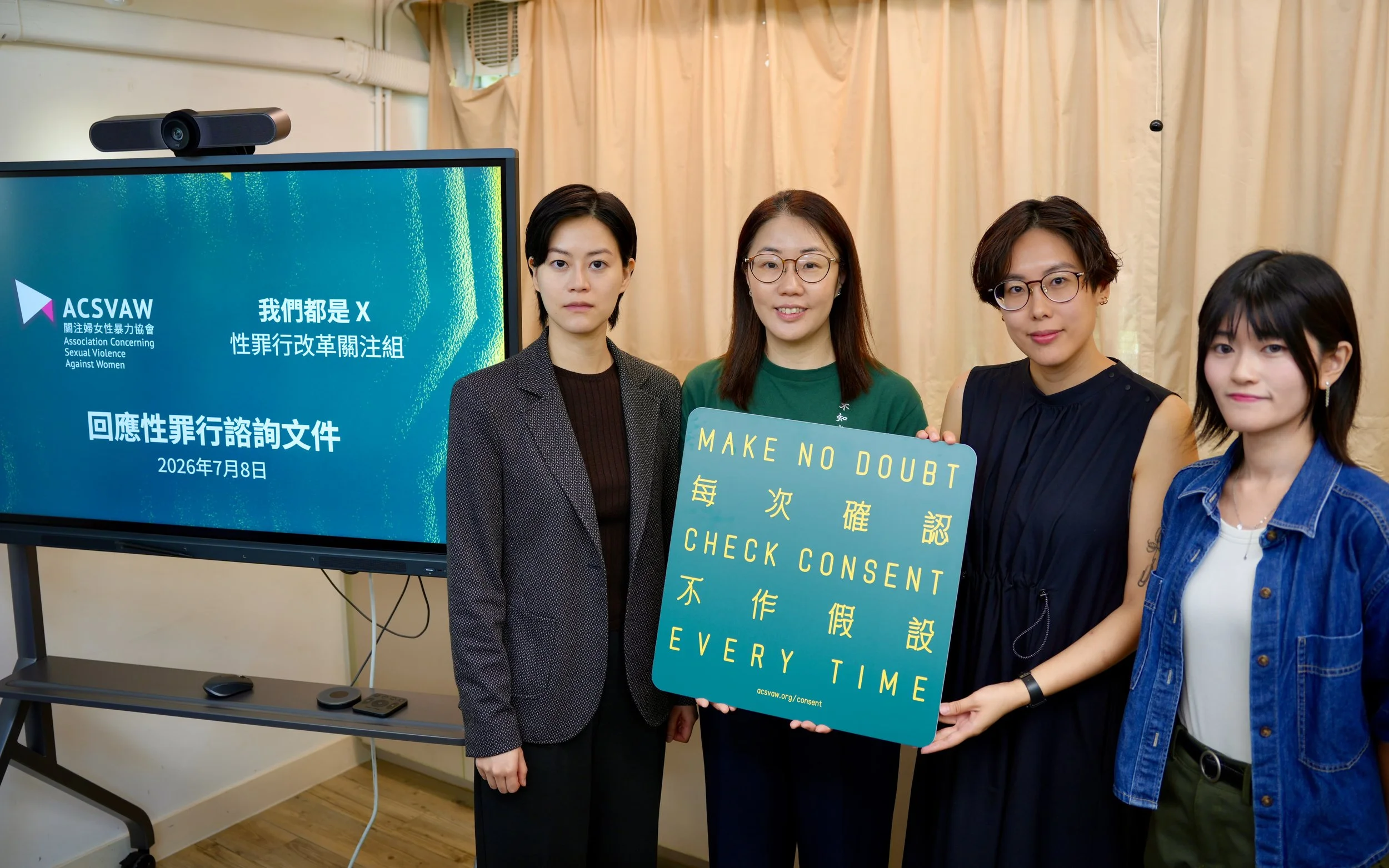


Group photo from left to right: Chelsea MA, Doris CHONG, Janelle, Tsz-ching
Please also refer to:
Towards a More Comprehensive and Timely Direction for Sexual Offence Law Reforms in Hong Kong (Earlier Publication)
Establishing a New Offence Against Persistent Child Sexual Abuse