
HKFP | Hong Kong NGO calls for legal reform as victims of non-consensual condom removal struggle to seek help
A total of 57 out of 277 respondents in the survey said they had experienced stealthing, also known as non-consensual condom removal.
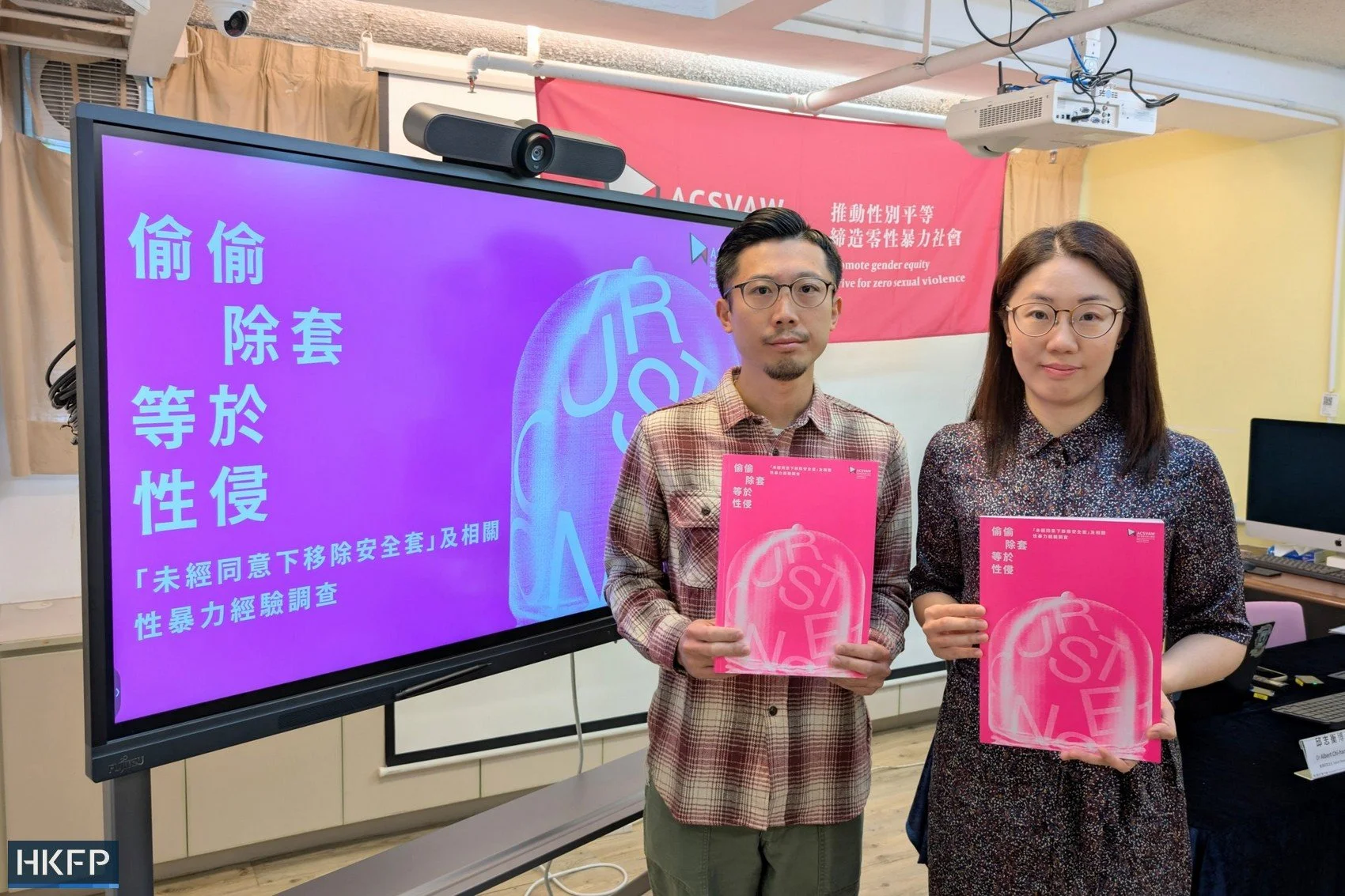
The lack of a “clear and explicit” legal definition of consent poses obstacles to victims of non-consensual condom removal when they try to seek help, a study conducted by an anti-sexual violence NGO has found.
Individuals who encountered the removal of a condom during sexual intercourse without their consent – commonly known as “stealthing” – have struggled to describe their experience of abuse because Hong Kong society is unfamiliar with the terminology, the Association Concerning Sexual Violence Against Women (ACSVAW) said in a press conference on Thursday.
The NGO conducted a questionnaire and in-depth interviews on non-consensual removal of condom without consent and related sexual violence in Hong Kong between October 2024 and February this year.
Among 277 respondents, of which 179 were cisgender female and 72 were cisgender male, more than 95 per cent identified stealthing as a breach of consent. Around 74 per cent considered the act a form of sexual assault.
The disparity showed that some people still had an “ambiguous” understanding of sexual violence, as they did not register that any sexual act without the person’s consent would constitute sexual violence, ACSVAW Senior Research Office Albert Yau said.
A total of 57 respondents indicated they had experienced stealthing. Among them, 40.4 per cent said the perpetrator was their intimate partner, while 36.8 per cent said the person was someone they met online.
In terms of follow-up action, 47.4 per cent said they tested for sexually transmitted infections after the incident, while 40.4 per cent sought emergency contraception. Only two of the 57 respondents said they reported the incident to the police. The force had terminated one of the cases, while the status of the other case was unclear.
The NGO said it was “worrying” that 21.1 per cent of the victims reported taking no follow-up action.
For victims who chose not to report to the police, more than half said it was because they believed the police would not follow up on their case. Another main reason for not reporting was because the process of filing a report was “too complicated.”
Ten victims who agreed to be interviewed by ACSVAW told the NGO that they saw sex with a condom and sex without one as “fundamentally different acts.” One victim described not wearing condom during sex as “an act of extreme intimacy.”
“The reason why I think this is a kind of rape is because… one thing is very clear, it is against my will,” a victim, using the pseudonym Lily, said in the interview.
The NGO said its study reflected that victims of stealthing saw different challenges when they tried to seek help or take follow-up action. The terminology is not widely known in Hong Kong society, making it difficult for victims to describe their experience to others. Public discussion on this kind of sexual violence was also insufficient, Yau said.
Individuals who experienced stealthing may also be seen as “imperfect victims” in a city that remains largely conservative about sex, Yau said. If the assault took place during a hook-up, people may hold biases against the victims, the researcher said.

Doris Chong, executive director of ACSVAW, said on Thursday that the authorities need to “take a closer look” at the legal definition of consent in Hong Kong’s rape laws and establish a “clear and explicit” definition. The city should also introduce a list of circumstances that would constitute a breach of consent.
“This would clearly criminalise such sexual assault behaviours, help the public recognise the seriousness of the issue, and most importantly, allow victim-survivors to affirm that their experiences are protected by sexual offence laws,” she said.
The NGO added that the government should step up public education and offer training to frontline professionals, such as law enforcement officers and medics, to ensure they would not neglect the health risks faced by the victims.
Medical information, including about emergency contraception and HIV Post-Exposure Prophylaxis treatment, should be more transparent and easily accessible, the group added.
In September, Chief Executive John Lee announced in the 2025 Policy Address that legislative amendments on sexual offences would be completed within his tenure. ACSVAW said at the time that the city’s rape laws were “outdated,” and that the legal definition of consent must be clarified.
Chong was asked by reporters whether she was worried that amendments to Hong Kong sexual offences may be hard to push for, given the lack of mention of the issue by the 161 candidates running in the “all-patriots” Legislative Council election.
In response, Chong said she hoped the election hopefuls would pay more attention to the topic of sexual violence, adding that the support of the legislature would be “vital” in pushing for the legal reform.
Since the statutory definition of rape was introduced into the Crimes Ordinance in 1978, Hong Kong has not updated its rape laws to incorporate affirmative consent, lagging behind other common law jurisdictions such as England, Scotland, Canada, and Australia.